
How to Vet a Moving Company in Texas: License Numbers, Insurance, and Red Flags
Get a Free Quote


Hiring a mover is one of the few purchases where you hand strangers everything you own and then watch them drive away with it. Most moving companies in North Texas are legitimate, careful operators. A small number are not, and the ones that are not tend to look identical to the ones that are until the truck is loaded and the price suddenly changes. The good news is that Texas gives you a free, public way to tell them apart in about ten minutes. This guide walks through exactly what to check, what the paperwork should say, and which warning signs are worth walking away from. At Brown Box Movers, we would rather you ask these questions of every company you call, including us.
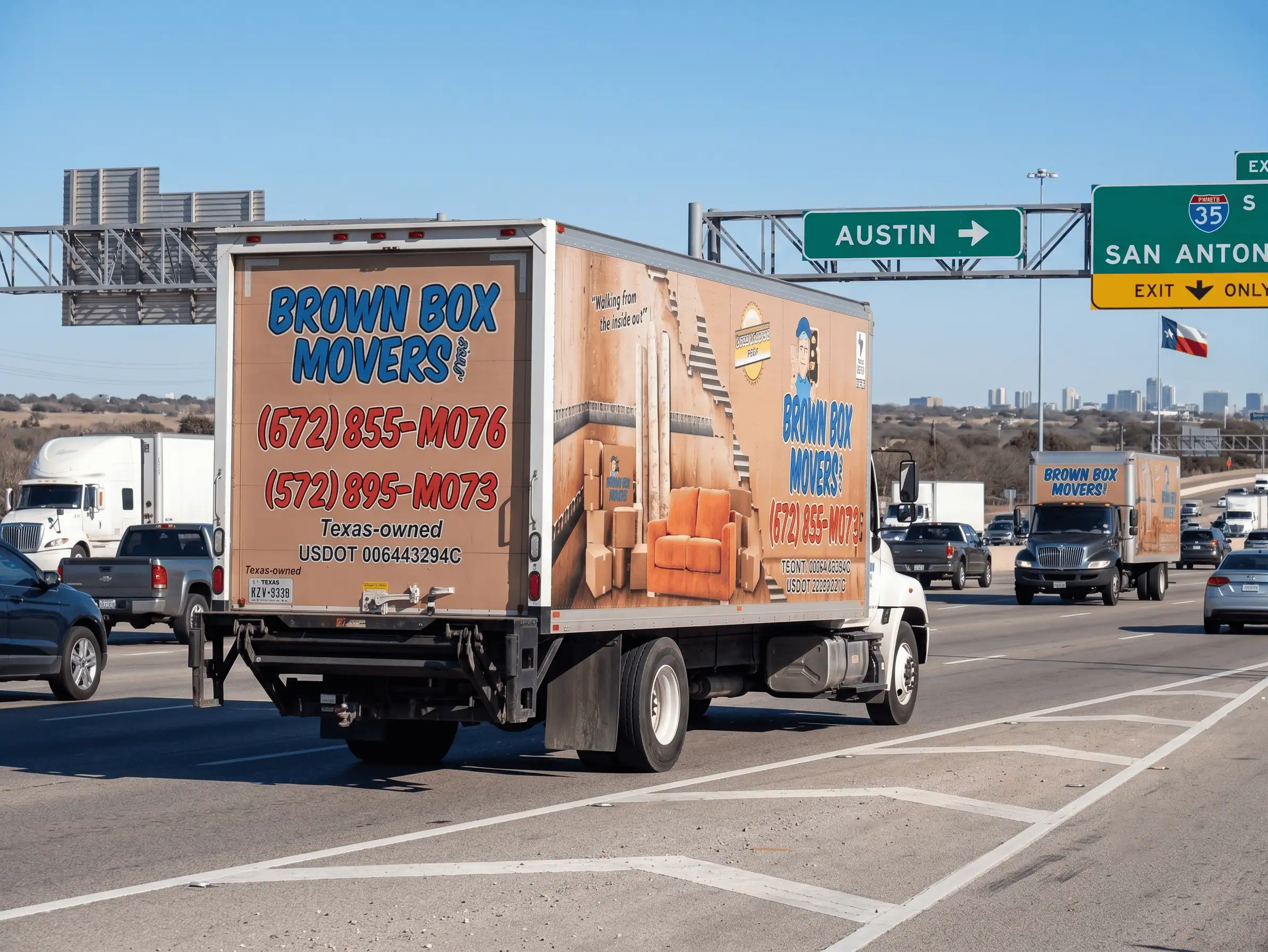
Any company that moves household goods within Texas is required to hold an active certificate from the Texas Department of Motor Vehicles. This is the single most important thing to verify, and it costs you nothing. Household goods carriers operating inside the state fall under the motor carrier rules in Chapter 218 of Title 43 of the Texas Administrative Code, and operating without an active certificate is illegal.
You can check any company yourself. TxDMV runs a free public lookup called Truck Stop on txdmv.gov, where you enter the company name or certificate number and see whether the licence is active and whether the carrier is authorised to move household goods. An active record displays a thumbs-up indicator. If the company you are considering does not appear, or appears without household goods authority, that is the end of the conversation.
The number is not supposed to be hard to find, either. Texas requires the licence number to be displayed on moving trucks, printed in online advertising, and shown on moving proposals and contracts. A company that advertises a local move without a visible certificate number is already out of step with the rules. This applies to every move that starts and ends inside the state, from a local move across Denton to a cross-state haul down to Houston.
Once your shipment crosses a state border, a different regulator takes over. Interstate household goods movers need a valid USDOT number and the operating authority that goes with it, both administered by the Federal Motor Carrier Safety Administration. The FMCSA runs a consumer site at ProtectYourMove.gov where you can look up a carrier before you book.
Interstate movers also owe you a specific document. Federal rules require them to give you a booklet called Your Rights and Responsibilities When You Move before the move. If a company moving you out of state has never mentioned it, ask for it. A mover who does not know what you are referring to is telling you something useful. We cover the rest of what federal rules entitle you to in our guide to interstate moving rights and responsibilities, which is worth reading before you sign anything for a long distance move.
Every mover in every advertisement says they are insured. The word does a lot of work and explains very little, so it pays to know what sits behind it.
An active TxDMV certificate already tells you something concrete: to hold one, an intrastate household goods carrier has to file and maintain proof of both liability and cargo insurance with the department. That is a floor, not a ceiling, and it is not the same thing as coverage for your belongings.
The coverage that affects your claim is called valuation, and on interstate moves federal rules give you two choices. Full Value Protection makes the mover liable for the replacement value of anything lost or damaged. Released Value costs nothing extra but caps the mover’s liability at 60 cents per pound, per article. That cap is harsher than it sounds. The FMCSA’s own example is a 25-pound television: under released value, the maximum recovery is $15, no matter what the set cost.
Two details are worth holding onto. Full Value Protection is the default on interstate moves, so if you end up on released value it is because something was signed, specifically a statement on the bill of lading. And items worth more than $100 per pound are treated as extraordinary value, which means they can be excluded from liability unless you declare them in writing. Jewellery, collectibles and some electronics land in that category more often than people expect. Our explainer on what licensed and insured really means goes further into how to read your paperwork.
A legitimate estimate is a document, not a number read out over the phone. It should name the company and its licence number, describe the services included, state how the price is calculated, and make clear whether it is binding or non-binding.
Be particularly careful with estimates produced without anyone seeing your home. A video or in-person survey takes twenty minutes and removes most of the room for a surprise on moving day. When a company quotes a suspiciously low figure sight unseen, the number is frequently a placeholder that grows once your belongings are already on the truck. If you are not sure what to probe, our list of questions to ask a moving company is built for exactly this call.
No licence number anywhere. Not on the website, not on the estimate, not on the truck. Texas requires it in all three places.
A large deposit demanded up front. Reputable movers in this market do not require substantial cash before the work starts.
A blank or partly blank document to sign. Never sign a bill of lading or inventory with empty fields. Whatever gets written in later is what you agreed to.
No physical address, or a name that keeps changing. Check that the business address is real and that the company has operated under one name long enough to have a history you can read. Ours is published on our contact page, and any established mover should be equally easy to locate.
Pressure to decide immediately. A genuine quote survives you thinking about it overnight.
The price changes after loading. This is the one that matters most. If a mover attempts to hold your belongings until you pay more than the agreed amount, that is not a billing dispute. TxDMV’s guidance is to contact law enforcement, and you can file a complaint through TxDMV.gov.
Run this on every company on your shortlist. It is short on purpose.
Look up the TxDMV certificate in Truck Stop and confirm it is active with household goods authority. For an out-of-state move, look up the USDOT number on ProtectYourMove.gov as well. Confirm the licence number appears on the written estimate. Ask which valuation options are offered and what each one costs. Ask whether the crew are employees or subcontracted. Ask for the estimate in writing after a video or in-home survey. Read recent reviews with an eye for how the company handled things when something went wrong, which tells you more than a wall of five-star ratings.
If you are moving within Denton County, it is also reasonable to ask how often a company actually works your area. A crew that runs Corinth and Argyle every week knows the building access, the HOA rules and the traffic patterns in a way an out-of-area crew does not.
None of the checks above are adversarial. They are the normal diligence that any established mover expects and most are glad to see, because the companies causing problems in this industry are the ones making it harder for everyone else.
We are happy to give you our certificate number, walk you through valuation options in plain language, and put the whole thing in writing after we have actually seen what needs moving. Request a free quote and ask us anything on this list.


