
Storage in Transit: What to Do When Closing Dates Do Not Line Up
Get a Free Quote


Two closing dates almost never meet. The sale completes on the eighth and the purchase on the twenty-second, the lease ends before the new build is finished, or the buyer’s lender asks for one more week and the whole chain shifts. The question is what happens to a house full of belongings in the gap. The answer is usually storage in transit, and it is a far better outcome than the alternatives people reach for first: renting a truck and parking it, moving twice, or paying for a hotel while a loaded trailer waits. Here is how it works and what it costs. Brown Box Movers runs storage alongside its moving operation in Denton.
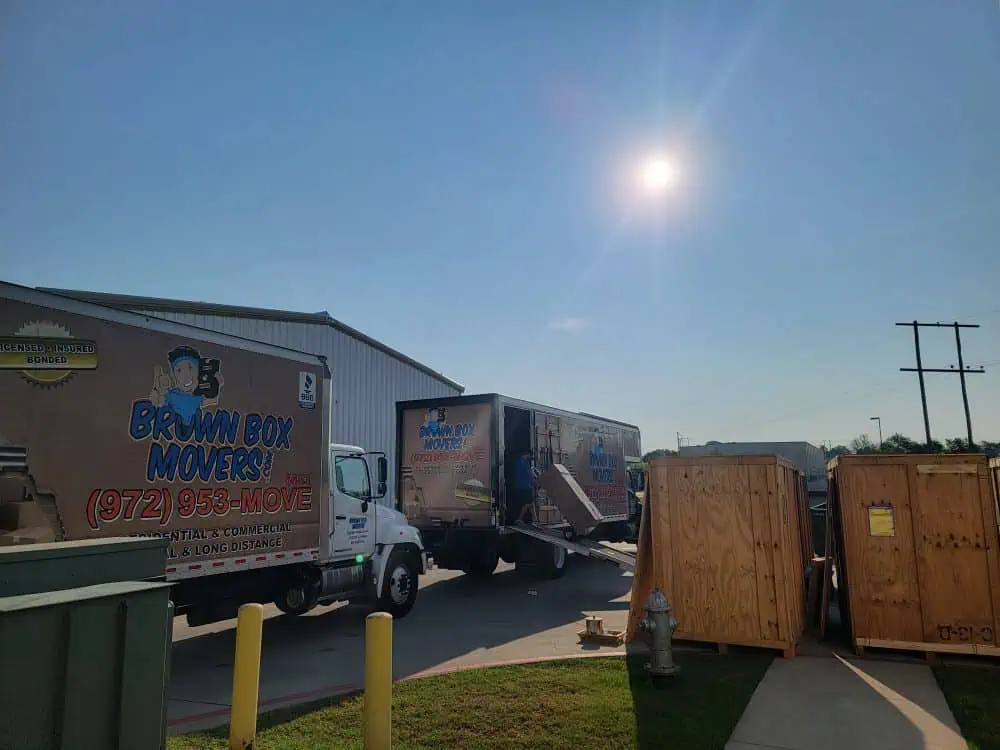
Storage in transit, usually shortened to SIT, is temporary warehouse storage of a shipment that is part-way through a move. Your mover collects as planned, takes the goods to a warehouse, holds them, and then delivers to the new address when you are ready.
The defining feature is that it is one continuous move rather than two separate jobs. Your belongings stay on the same inventory, under the same paperwork, in the care of the same company from collection to final delivery. Nobody hands anything over to a third party, and nobody loads or unloads an extra time.
In most warehouses, including ours, goods are stored in wooden vaults: large sealed containers packed once at collection and not reopened until delivery. If you want the detail on how that works, we have covered what wooden vault storage is and what fits in a vault separately.
A self-storage unit looks cheaper per month, and on the monthly rate alone it often is. The comparison usually changes once the handling is added back in.
Handling. With a self-storage unit, somebody unloads the truck into the unit and later loads it back out. That is two additional handling events you are paying for, either in labor charges or in your own weekend, and every handling event is an opportunity for damage.
Protection. Goods in SIT normally remain under the valuation coverage attached to your move. Once belongings are deposited in a unit you rent yourself, that coverage typically ends and you are relying on a self-storage insurance product, which is a different thing with different limits.
Inventory. SIT keeps the numbered inventory from collection, so there is a documented record of what went in. A self-storage unit you loaded yourself has no inventory unless you made one.
Coordination. With SIT, one phone call releases the shipment for delivery. With a unit, you are booking a second move and hoping a crew is free on the date your closing finally lands.
Self-storage wins when the gap is long, when you need regular access, or when you are storing a small number of things you could carry yourself. SIT wins for whole-house gaps of a few days to a few months.
SIT is normally priced on the volume or weight of the shipment and the time it is held, with handling charged separately.
Warehouse handling. A charge for moving goods into and out of the warehouse. It is a fixed cost that does not vary with how long you store, which is why a one-week gap is proportionally more expensive than a two-month one.
Storage itself. Charged by the month or part month in most cases, based on how much space the shipment occupies.
Final delivery. The delivery leg out of storage to the new address, which may differ from the original quote if the destination has changed or the access is harder than planned.
Ask for all three lines separately and in writing. A single storage figure with no breakdown makes it impossible to tell what happens if the gap doubles, which on a property chain it very well might.
On interstate moves, storage in transit is a defined service with a time limit, after which the shipment converts to ordinary permanent storage. That conversion matters because the terms change with it: the move is treated as complete, and the valuation coverage that applied during transit generally ends.
If there is any chance of a long delay, ask your mover two questions before you commit. How long can the shipment stay in transit status, and exactly what changes when it converts. You want those answers in writing before the truck is loaded, not after a closing date slips.
This is the main practical limitation of SIT, and it catches people out. Once a vault is sealed and stacked in a warehouse, you cannot wander in and retrieve a jacket. Access, where it is offered at all, requires notice and usually a fee, because somebody has to bring the vault down and open it.
Plan around it rather than against it. Anything you will need during the gap travels with you: documents, medication, laptops, chargers, seasonal clothing, school uniforms, and anything with a deadline attached. Pack and label those boxes separately and keep them out of the shipment entirely.
If the gap is genuinely uncertain, tell the surveyor. A shipment that may need partial access can sometimes be loaded so the likely items are reachable, but only if someone knows before it is packed.
Warehouses have rules, and most of them exist for good reason. Perishable food, plants, aerosols, paint, propane, fuel, fireworks and anything else flammable or corrosive are refused everywhere. Candles, vinyl records and some electronics do badly in a non-climate-controlled space during a North Texas summer. Cash, jewelry, passports and irreplaceable documents should never go into any storage, in transit or otherwise.
Our guide to what not to put in storage covers the full list, and preparing items for long-term storage covers how to treat furniture, appliances and mattresses so they come out in the condition they went in.
The cheapest time to arrange storage is before you need it. Once a crew is loaded and waiting, you are negotiating from the worst possible position and taking whatever is available.
When you book the move, ask for SIT to be priced as a contingency even if you expect the dates to hold. It costs nothing to have the quote and it converts a crisis into a phone call. Realtors see this constantly, which is why moving timelines in Denton County is worth reading if you are mid-chain.
Three things make the contingency actually work. Tell your mover as early as possible that the dates are soft. Keep the survival boxes out of the shipment from the start. And agree in writing how much notice the mover needs to schedule the delivery out of storage, which is typically several days rather than the next morning.
Storage in transit is one of those services that is unremarkable when it is arranged in advance and painful when it is not.
We hold goods in secure vault storage at our Denton facility between collection and delivery, on the same inventory and the same paperwork as the move itself, for local and long distance jobs alike. Tell us your dates and how firm they are, and we will quote the gap alongside the move. Request a free quote to start.


