
What a Dedicated Truck Move Means and When It Is Worth Paying For
Get a Free Quote


When people get quotes for a move from Denton to Denver or Los Angeles, two numbers usually come back and they are often thousands of dollars apart. The gap is rarely about crew quality. It is almost always about whether your belongings are travelling on a truck shared with other households or on a truck carrying nothing but yours. That second arrangement is called a dedicated truck move, and it solves a specific set of problems at a specific price. This guide explains what you are actually buying, and when it is worth it. Brown Box Movers quotes both, because for a lot of moves the cheaper option is genuinely the right one.
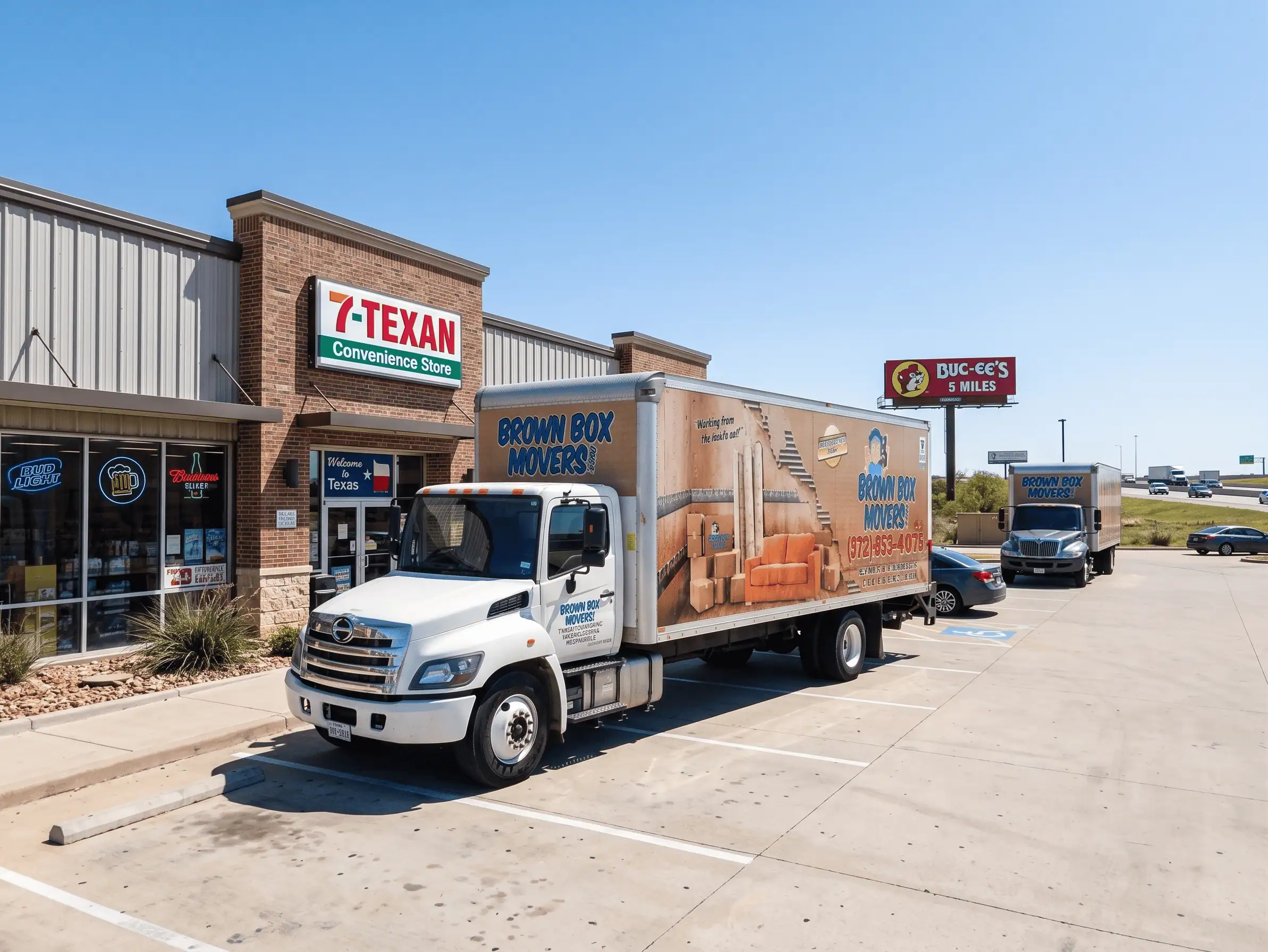
Most long distance household moves travel consolidated. Your shipment is weighed, inventoried and loaded alongside two or three other households heading in roughly the same direction, and the truck runs a route that serves all of them.
This is efficient and it is why standard long distance moving costs what it does. You pay for the space and weight your belongings occupy rather than for an entire vehicle and driver. The trade-off is control. Because the truck is serving several customers, your delivery is quoted as a window rather than a date, and that window widens with distance.
For a run from Denton to Oklahoma City the spread might be a couple of days. For Denton to Chicago or further, a week to ten days is common and entirely normal. Nothing has gone wrong when that happens; it is the product working as designed.
On a dedicated move, one truck carries your household and nothing else. It loads at your home, drives to your destination, and unloads. There is no other customer on the vehicle, no intermediate stops to serve someone else, and usually no transfer of your belongings between trucks or warehouses along the way.
Three things follow from that. You get a delivery date rather than a window, because the only variable is the drive itself. Your belongings are handled fewer times, and handling is where damage happens. And the crew that loads is frequently the crew that unloads, which means the people putting your furniture back together are the people who took it apart.
It is worth being clear about what dedicated does not mean. It is not faster per mile, it does not change how your furniture is wrapped and padded, and it is not a different standard of care. Good packing matters just as much either way.
If you remember one thing from this article, make it this. The headline difference is not speed and it is not safety. It is certainty about the date.
A consolidated shipment gives you a range because the carrier is sequencing several households. A dedicated truck gives you a date because there is nothing to sequence. Whether that certainty is worth paying for depends entirely on what else is tied to the date, which is the question the rest of this article is really about.
Expect a dedicated move to cost meaningfully more than the consolidated equivalent for the same household and distance. Rather than quote a multiplier that will not hold across routes and seasons, it is more useful to understand what drives it.
On a consolidated move the fixed costs of the trip, the vehicle, the fuel and the driver’s time, are shared across several customers. On a dedicated move you carry all of them. The gap therefore narrows as your shipment gets larger, because a big household already fills most of a truck and there was never much space to share. A five-bedroom home moving dedicated is a far smaller premium than a one-bedroom apartment moving dedicated, where you would be paying for a lot of empty trailer.
This is also why the advice splits so sharply by household size. Smaller shipments get the worst value from dedicated transport, and are usually better served by a consolidated move with realistic expectations about the delivery window, or by putting things into storage and timing the delivery deliberately.
A hard date on the other end. A lease that starts on a fixed day, a closing that cannot move, or a job start date that leaves no slack. If being wrong by a week costs you a hotel and a storage unit, the premium starts looking reasonable.
You cannot be without your belongings. People working from home who need equipment, families with young children, anyone for whom a week on an air mattress is not a joke but a genuine problem.
High-value or irreplaceable items. Fewer transfers means fewer opportunities for damage. If your shipment includes antique furniture, a piano, artwork or anything you would be devastated to lose, the reduced handling is part of what you are buying, not just the schedule.
A large household moving a long way. As above, the premium shrinks as volume grows, so the calculation flips in your favour.
A move the company is paying for. If a relocation package covers it, take the certainty.
If your dates are genuinely flexible, you are moving a modest household, and you can live out of a suitcase for a week without real inconvenience, a dedicated truck is money spent on a problem you do not have.
The same applies if your timeline has natural slack, for instance if you are staying with family at the destination for a fortnight anyway. In that situation the delivery window costs you nothing and the saving is real. Our guide to planning a long distance move covers how to build that slack in deliberately.
Ask whether the quote is for dedicated or consolidated transport, because some quotes do not say and the difference explains most price gaps. Ask for the delivery window in writing, as a range of dates rather than a vague reassurance. Ask whether your belongings will be transferred between vehicles or warehoused in transit, and how many times they will be handled.
Ask whether the delivering crew is the loading crew. Ask what happens, specifically, if delivery falls outside the quoted window. And confirm what valuation coverage applies, which matters more on a long route than a short one. Our guide to interstate moving rights and responsibilities explains what federal rules entitle you to, and long distance furniture moving covers how the larger pieces should be prepared.
The honest answer is that neither option is better in the abstract. A dedicated truck buys certainty and reduced handling; a consolidated move buys a lower price in exchange for flexibility you may well have.
What you should not do is choose blind. Ask for both quoted side by side, with the delivery window written down for each, and the decision usually makes itself. Request a free quote and we will price it both ways.


